Kitchen Fire Suppression System: Protecting Commercial Cooking Lines
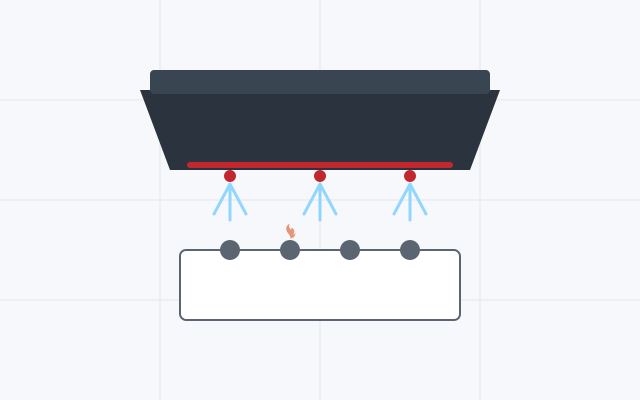
A commercial kitchen is one of the most demanding fire environments in any building. Open flames, superheated surfaces and large volumes of cooking oil sit within centimetres of combustible grease deposits. The moment a fire starts, it climbs into the extraction hood and ductwork, where ordinary firefighting cannot reach it. A properly engineered kitchen fire suppression system is the fixed, automatic defence built for that hazard. This guide explains why commercial cooking is a special case, why grease fires demand a wet-chemical agent, and how hood, duct and appliance nozzles combine with fuel shut-off to stop a fire in seconds.
Why commercial kitchens are a special fire risk
Domestic cooking scaled up is not the same thing as commercial cooking. It is a different problem. A busy restaurant or hotel line runs char-grills, ranges, deep fryers and salamanders for many hours a day, at temperatures no home kitchen sustains. Every one of those hours releases grease-laden vapour that condenses on the underside of the canopy hood and along the whole run of the extract duct. Over a few weeks that builds into a continuous film of combustible fuel, lining the very path a fire will travel.
The result is a hazard with three uncomfortable features. First, the ignition source is always present: an unattended fryer, a boil-over onto a burner, or a flare-up on a grill can start a fire in seconds. Second, the fuel is concentrated: cooking oil has an enormous heat of combustion and burns fiercely once it reaches its auto-ignition temperature. Third, the fire hides: it does not stay on the cooktop but is drawn upward into the hood plenum and along the duct, where staff cannot see it and a handheld extinguisher cannot follow it. A fixed kitchen fire suppression system exists precisely because these fires start where people are and then retreat to where they are not.
Grease is the fuel that lines the escape route
The most dangerous fire in a commercial kitchen is rarely the one on the pan you can see. It is the one that has already been pulled into a grease-coated duct, out of reach and out of sight. Protecting the cooking surface alone is not enough. The hood and the duct have to be protected too.
Why grease fires need a wet-chemical agent
The single most important thing to understand about kitchen fire protection is why you must never fight a grease fire with water. Cooking oil burns at a temperature well above 300 °C, far hotter than the 100 °C at which water boils. When water lands on burning oil it flashes instantly to steam, expanding roughly seventeen-hundred-fold, and that violent expansion throws burning oil outward as a fireball. A water sprinkler head or a water extinguisher does not put a grease fire out; it spreads it explosively. This is why a general building sprinkler is not a substitute for a dedicated kitchen fire suppression system.
Wet-chemical agents solve the problem chemically rather than by drowning it. The agent, typically a potassium-based alkaline solution, is discharged as a fine spray straight onto the burning fat. It does three things at once. It cools the surface below the oil's auto-ignition temperature, so the fire cannot re-establish. It reacts with the hot fatty acids in a process called saponification, in which the alkali and the fat form a thick, soap-like foam. That foam then floats on the oil as a sealing blanket and shuts out oxygen. The blanket is stable, the oil has been cooled, and so the fire cannot reignite once the flame is knocked down. Reignition is exactly the failure mode that makes grease fires so lethal.
Saponification in one sentence
The wet-chemical agent turns the burning cooking oil into a cool, oxygen-sealing soap layer. That smothers the fire and, by preventing reignition, keeps it out.
How a kitchen fire suppression system works
A fixed kitchen fire suppression system is a pre-engineered assembly that sits above and around the cooking line. Its core components work together as one automatic circuit:
- Agent tank: a stainless steel cylinder holding the wet-chemical agent, sized to the number and type of appliances protected.
- Gas cartridge or pressurised expellant: the stored energy that drives the agent through the pipework when the system fires.
- Distribution pipework and nozzles: corrosion-resistant pipe routing agent to purpose-built nozzles aimed at the hood, the duct opening and each appliance.
- Detection line: a cable of fusible links (or a comparable heat detector) strung across the hood. Heat from a fire melts a link and releases the tension that triggers the system.
- Mechanical or electrical release: the control head that, once triggered, punctures the cartridge and starts the discharge.
- Manual pull station: a clearly marked, reachable handle on the escape route so a person can fire the system before the links melt.
- Fuel shut-off interlock: a gas valve or electrical contactor that cuts the appliances' fuel supply the instant the system operates.
When a fire develops, heat rises into the hood and melts a fusible link. The detection line loses tension, the release mechanism drives the expellant gas into the agent tank, and the wet-chemical agent is forced through the pipework and out of every nozzle simultaneously. Within seconds the cooking surfaces, the hood plenum and the duct entrance are flooded with agent, the fuel is shut off, and the fire is starved of both heat and oxygen. The whole sequence is automatic and requires no one to be present.
Automatic and manual activation, and fuel shut-off
Reliability comes from two independent ways to activate, and from one consequence that is not negotiable when either of them fires. Automatic activation via the fusible-link detection line protects the kitchen even when nobody is there: overnight, during a lull, or after staff have evacuated. Manual activation via the pull station lets a person who spots a fire early trigger suppression at once, without waiting for a link to reach its melting temperature. Both routes converge on the same release mechanism.
The fuel shut-off interlock is what separates a compliant system from a mere agent sprayer. Discharging agent onto a fire while the burners keep pumping out heat is a losing battle: the appliance simply re-feeds the flame. So the moment the system operates, the interlock closes the gas supply (through a mechanical gas valve held open by system pressure, or a solenoid valve) and de-energises electric appliances. Removing the heat source is what makes the knock-down permanent. Many installations also signal the building fire alarm and, where required, an emergency ventilation response.
An interlock is not optional
A kitchen fire suppression system without automatic fuel shut-off is incomplete. If the gas or power to the appliances is not cut on discharge, the fire can be re-fed the moment the agent runs out. Always confirm the interlock is installed, tested and working at every service.
Coverage, nozzles and appliance mapping
A kitchen fire suppression system is not a single spray head. It is a carefully mapped set of nozzles, each one chosen and aimed for the specific thing it protects. Different appliances present different fire geometries, so the design assigns nozzle types and positions to match. A deep fat fryer needs a nozzle that covers the whole oil surface. A char-broiler needs coverage of the grate area. A range or hob needs a nozzle over each burner cluster. The hood plenum and the duct entrance each get their own dedicated nozzle, so a fire cannot escape upward unopposed.
The number of nozzles and the volume of agent follow from an appliance schedule drawn up during the design survey. Rearrange the cooking line later (a fryer swapped for a griddle, an extra burner added, appliances shifted along the run) and the nozzle coverage may no longer match what is actually under the hood. At that point the system has to be re-engineered. This is one of the most common ways a previously compliant kitchen falls out of protection without anyone noticing.
| Zone | Fire risk | Nozzle approach |
|---|---|---|
| Deep fat fryer | Large volume of hot oil; high reignition risk | Appliance-specific nozzle covering the full oil surface |
| Char-grill / broiler | Open flame, dripping fat, radiant heat | Nozzle aimed across the cooking grate |
| Range / hob | Multiple burners, boil-overs, pan fires | Nozzle per burner cluster |
| Hood plenum | Condensed grease, filter fires | Dedicated plenum nozzle behind the filters |
| Extract duct | Grease-lined, hidden, draws fire upward | Duct nozzle at the collar to seal the opening |
Approvals and standards concept
Commercial kitchen suppression is a highly standardised field, and the value of a system rests on it being a tested, listed assembly rather than an improvised collection of parts. Two ideas are worth understanding without getting lost in clause numbers.
The first is the UL 300 listing concept, familiar from North America and widely referenced elsewhere. Pre-engineered wet-chemical kitchen systems are tested as a complete package (tank, agent, pipework limits, nozzle types and appliance coverage) against realistic grease-fire scenarios, then listed only for installation within those tested limits. You cannot mix a nozzle from one listing with a tank from another and still claim the approval. The second is the European standard EN 16282-7, which covers installations for fire protection and fire suppression over commercial cooking appliances, and sits within the wider EN 16282 series on kitchen ventilation. Both frameworks point the same way: a fixed, tested, wet-chemical system that relies on saponification of the burning fat, installed exactly as its listing permits and maintained so that listing stays valid.
The practical takeaway is simple. A compliant kitchen fire suppression system is only compliant as installed and as maintained. Design, installation and servicing all have to stay inside the tested envelope. Independent engineering advice, separating what your kitchen actually needs from what a single manufacturer happens to sell, is where VAALMAX adds value. See our overview of fire suppression systems and agent types for the wider picture.
Ventilation and grease-duct cleaning
The suppression system and the ventilation system are two halves of the same fire-safety strategy, and neither works properly without the other. The extraction hood and duct exist to carry grease-laden vapour out of the kitchen. In doing so they accumulate the very fuel a fire will feed on. A system that suppresses a cooktop fire but ignores a duct caked in months of grease has protected the wrong thing.
This is why grease-duct cleaning is not housekeeping but fire safety. The cleaning interval depends on how heavily the kitchen is used: a high-volume, char-grill-based operation running all day accumulates grease far faster than a light-use café and needs more frequent cleaning. When ductwork is cleaned, technicians should also confirm that the suppression nozzles serving the hood and duct have not been fouled or knocked out of alignment. Ventilation balancing matters too: excessive airflow across the cooking line can pull agent away during a discharge, which is one reason the suppression and ventilation designs must be coordinated. For how these systems are commissioned together, see our guide to fire extinguishing system installation.
Inspection and maintenance intervals
A kitchen fire suppression system is a mechanical device holding stored energy, and its readiness degrades quietly if it is left alone. Grease migrates onto nozzles and blocks them. Fusible links corrode. Cartridge pressure can drift. Interlocks get disconnected during unrelated maintenance and never reconnected. None of this shows on the surface, which is why a documented service regime, not appearance, is the real measure of a working system.
Recognised practice combines daily staff vigilance with periodic professional service, typically at roughly six-monthly intervals. At each service a competent technician works through a defined routine.
- Confirm the agent tank is at correct weight/level and the expellant cartridge holds pressure.
- Inspect and, as standard, replace the fusible links so their melting temperature stays reliable.
- Check every nozzle for grease blockage and correct aim, replacing protective caps.
- Verify the manual pull station is unobstructed, clearly marked and operates freely.
- Function-test the fuel shut-off interlock, proving gas and electrical supplies actually cut on activation.
- Confirm the detection line tension, pipework security and any alarm signalling.
- Record the appliance schedule and confirm the coverage still matches the cooking line as it stands today.
- Issue a dated, signed service certificate for the site's fire-safety records and insurer.
Neglect has consequences beyond the obvious safety risk: an unserviced or modified system can invalidate insurance cover and leave the operator exposed after a fire. Our dedicated article on fire suppression system maintenance covers the full inspection regime in depth.
Two people, two habits
The best-protected kitchens pair a nightly staff walk-through (filters clean, nothing blocking the pull station, appliances off) with a documented six-monthly service by a competent engineer. Routine and records together keep the system ready.
Who needs a kitchen fire suppression system
The short answer is any premises where commercial cooking produces grease-laden vapour over an extraction hood. In practice that means restaurants and gastro-pubs, hotel and resort kitchens, catering and banqueting facilities, staff canteens, school and hospital kitchens, dark or ghost kitchens serving delivery-only brands, bakeries and takeaways running deep fryers, and food courts in retail and leisure buildings. Wherever there is a fryer, a char-grill or a busy range under a canopy hood, a fixed wet-chemical kitchen fire suppression system is the right control. Increasingly it is also the one insurers and authorities expect to see, rather than a portable extinguisher on the wall.
If you operate any of these, the right starting point is an independent survey of your cooking line, hood and duct, followed by a system designed to your actual appliance schedule. VAALMAX handles that survey, the design, the installation and the ongoing service under one accountable contract. Explore our fire-protection services or request a consultation to begin.
Frequently asked questions
Why can't I use a water sprinkler or a standard extinguisher on a grease fire?
Cooking oil burns at a temperature far above the boiling point of water. Water hitting hot grease flashes to steam instantly and ejects burning oil outward, spreading the fire violently. A commercial kitchen fire suppression system instead discharges a wet-chemical agent that reacts with the fat to form a cooling, soap-like blanket through saponification, smothering the fire and preventing reignition.
Does a kitchen fire suppression system shut off the gas automatically?
Yes. A compliant kitchen fire suppression system is interlocked with a mechanical or electrical shut-off that cuts the fuel supply, gas or electricity, to the appliances under the hood the moment the system activates. This removes the heat source so the fire cannot be re-fed once the agent has knocked it down.
How often must a commercial kitchen fire suppression system be serviced?
Recognised practice is a documented professional inspection at roughly six-monthly intervals, together with routine visual checks by staff. The agent tank, cartridge, nozzles, fusible links and interlocks are examined, links are typically replaced at each service, and the extract ductwork is cleaned on a schedule matched to how heavily the kitchen is used.
Which businesses need a kitchen fire suppression system?
Any premises with commercial cooking that produces grease-laden vapours: restaurants, hotels, catering kitchens, canteens, dark kitchens, bakeries with deep fryers and fast-food outlets. Insurers and authorities increasingly treat a fixed wet-chemical system over the cooking line as an expected control, not an optional extra.
In summary
Commercial cooking concentrates heat, oil and grease along the exact path a fire wants to travel: the cooktop, the hood and the duct. Water makes grease fires worse, so a kitchen fire suppression system uses a wet-chemical agent that cools the oil and saponifies it into an oxygen-sealing blanket that resists reignition. Purpose-aimed hood, duct and appliance nozzles, automatic and manual activation, and an automatic fuel shut-off interlock work as one circuit, installed within a tested UL 300 or EN 16282-7 listing and kept ready by a documented six-monthly service. If you run a restaurant, hotel or catering kitchen, this is the fixed protection your cooking line needs, and VAALMAX can design, install and maintain it end to end.
Protect your kitchen the right way
Tell us about your cooking line, hood and duct. We will survey the risk and recommend a compliant kitchen fire suppression system, with no obligation.