
Server Room Fire Suppression: Clean-Agent and Inert-Gas Protection
A server room is one of the few places where the traditional answer to fire, water, is often the worst possible choice. The equipment is live. It is packed tight. It is irreplaceable, and a single soaking can destroy far more value than the fire itself. This guide explains how modern server room fire suppression protects data rooms and small data centres with gaseous clean agents and inert gases that extinguish a fire in seconds and leave nothing behind.
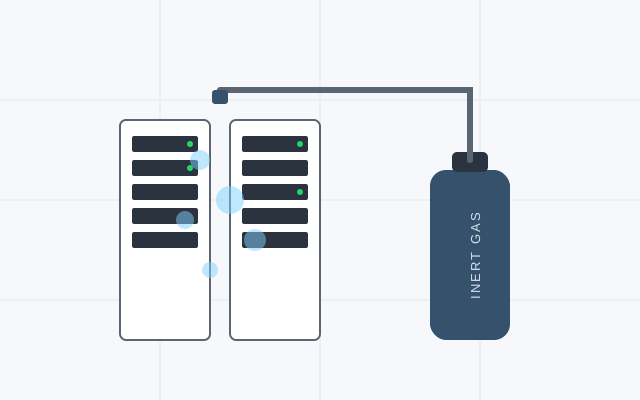
Why water and sprinklers are wrong for live IT
Conventional building fire protection assumes that soaking the fire is acceptable collateral. In an office corridor it is. In a server room it is not. Server room fire suppression has to reckon with three facts that ordinary sprinkler design ignores: the equipment is energised, the equipment is packed tightly, and the value at risk is mostly the data, not the hardware.
Spray water onto energised switchgear, power distribution and server power supplies and you invite short circuits and arc faults across the very racks you are trying to save. Water also carries dissolved minerals. Once it evaporates it leaves conductive residues on boards and connectors that go on causing faults for weeks. Corrosion of copper traces, gold contacts and cooling fins begins within hours. A fire confined to one rack might be knocked down by a few litres of water, but that water then runs across the raised floor into cable trays and neighbouring cabinets and spreads the damage well beyond the ignition point.
Pre-action sprinkler systems, sometimes proposed as a compromise, only reduce the risk of an accidental discharge; they do not change what happens once water is released onto live IT. The moment they operate, everything under the spray pattern is wet. For a room whose entire purpose is continuity of service, that is rarely an acceptable outcome.
The real loss is downtime and data
When a data room floods, the direct cost of replacing hardware is often the smallest line on the invoice. The larger costs are unplanned downtime, lost transactions, recovery of data from backups, and the reputational damage of an outage. Effective server room fire suppression is judged by how much of the room keeps running, not merely by whether the flames went out.
How gaseous suppression extinguishes without residue
Gaseous suppression floods the entire protected volume with a fire-extinguishing gas that is stored under pressure in cylinders outside or beside the room. On a confirmed fire signal the agent is released through a network of pipes and nozzles and mixes evenly with the air in seconds. Because the extinguishant is a gas, it reaches every corner of every cabinet: behind blanking panels, inside cable ducts, under the raised floor, without leaving liquid, powder or residue on anything it touches. Design, discharge and hold-time calculations follow the clean-agent standards EN 15004 and ISO 14520, with NFPA 2001 covering the same ground in North American practice.
Two mechanisms are at work across the different agent families. Inert gases extinguish physically: they dilute the oxygen in the room below the level combustion needs, without any chemical reaction and without cooling. Chemical clean agents work mainly by absorbing heat from the flame and interrupt the combustion reaction at a far lower concentration. Either way the fire is starved or quenched rather than drowned, and once the room is ventilated the gas simply disperses. Nothing to mop up, nothing to dry out, no cleaning bill.
This is why gaseous systems are the default for rooms full of sensitive electronics. They combine the certainty of total-flooding suppression with the gentleness the equipment demands. There is a catch. A gaseous system only works in a room that can hold the gas long enough to do its job, which is why the room sealing covered below matters as much as the cylinders themselves.
Total flooding, not local spray
Server room systems are almost always designed as total-flooding systems: the whole room is treated as one sealed volume and brought to a uniform extinguishing concentration. This protects hidden fire seats you cannot see and copes with a fire that moves from cabinet to cabinet. It also means the room boundary is part of the fire-protection system. Walls, floor, ceiling, doors and every penetration through them all count.
The main agent families compared
There is no single best agent for every data room. The right choice depends on room size, ceiling height, how much cylinder storage space you have, occupancy, and your environmental priorities. Broadly, gaseous server room fire suppression falls into two families, plus a specialist third option.
Inert gases are naturally occurring gases: nitrogen, argon, or engineered blends of the two, sometimes with a small proportion of carbon dioxide (often marketed under IG- designations). They are non-conductive, leave zero residue, have effectively no global-warming or ozone impact, and never break down into by-products. Because they extinguish by lowering oxygen, they are stored at high pressure and need more cylinders and more storage space than chemical agents. Discharge is deliberately gentle and a little slower, which keeps the pressure swing on the room within bounds.
Chemical clean agents are engineered fluids stored as a liquid and discharged as a gas. The well-known families are the HFC-type agents and the newer fluoroketone (FK) agents. They extinguish at a much lower volume concentration, so they need far fewer, smaller cylinders and can sit close to the room. Environmental profile is where they differ most. Older HFC types carry a high global-warming potential; fluoroketone agents were developed specifically for a very low global-warming potential and a short atmospheric lifetime. Under the F-gas rules now in force across much of the industry, that difference increasingly decides the specification.
Condensed aerosol systems are a compact alternative for smaller enclosures and standalone cabinets, using a solid compound that generates a fine extinguishing aerosol. They are not a true clean agent, since a light residue can settle, so they are usually reserved for equipment cabinets rather than full occupied rooms.
| Property | Inert gas (N₂ / Ar / IG-blends) | Chemical clean agent (HFC / fluoroketone) | Condensed aerosol |
|---|---|---|---|
| Extinguishing mechanism | Oxygen reduction (physical) | Heat absorption / reaction interruption | Chemical interruption via aerosol |
| Residue on equipment | None | None | Slight residue possible |
| Storage space needed | Large (high-pressure cylinders) | Small (liquefied agent) | Very small |
| Cylinders near / away | Often a remote bank | Can sit beside the room | Point devices in-room |
| Environmental note | Negligible GWP, no by-products | Ranges from high (HFC) to very low (FK) GWP | Ozone-safe, low GWP |
| Typical use | Larger occupied data rooms | Space-limited rooms, fast discharge | Cabinets, small enclosures |
Very-early smoke detection (VESDA-type)
Suppression is the last line of defence; detection is the first. The best outcome is one where a smouldering fault is caught so early that no discharge is ever needed. That is the job of very-early aspirating smoke detection, widely known by the VESDA brand name.
An aspirating system runs a network of small-bore sampling pipes across the ceiling, inside cabinets and under the raised floor. A central unit continuously draws room air back through those pipes and passes it over an extremely sensitive laser scattering chamber. Because it is actively sampling rather than waiting for smoke to drift to a fixed point, it can detect the faint gases given off by an overheating cable or a failing power supply at a stage a conventional detector would miss entirely. This is the highest-sensitivity class of aspirating detector defined in EN 54-20. Staff get a warning, sometimes hours of it, to isolate the offending circuit before there is a flame at all.
For the suppression system to release, most designs require detection from two independent zones or detector types, so-called double-knock or cross-zoning. This confirmation prevents an expensive and disruptive discharge from a single spurious signal while still guaranteeing a fast response to a genuine fire.
- Multi-level sampling: pipes at ceiling level, within racks and under the floor void catch fires wherever they start.
- Continuous air sampling: the detector never waits for smoke to reach it; it brings the air to the detector.
- Cross-zoned release: two confirming signals are required before any agent discharges.
- Graduated alarms: alert, action, fire and pre-discharge stages give staff time to intervene.
- Isolation before discharge: early warning lets you shut down or fix a circuit before a gas dump is needed.
Room integrity, hold time and pressure relief
A gaseous system can only protect a room that keeps the gas in place. After discharge, the extinguishing concentration has to hold long enough for the equipment and its surroundings to cool below re-ignition temperature. That period is the concentration hold time, and it is commonly specified as ten minutes. If the agent leaks away faster than that, the fire can reignite and the whole investment is wasted.
Gas escapes through every gap: the undercut beneath a door, cable and pipe penetrations, poorly sealed floor and ceiling voids, even ordinary construction cracks. That is why every gaseous installation should be commissioned with a door-fan integrity test, the room-integrity procedure set out in EN 15004 and ISO 14520. A calibrated fan pressurises the room, measures its total leakage and predicts how long the concentration will actually hold. A room that fails is sealed and retested until it passes. Room integrity is not a formality; it is the difference between a system that works and one that only looks reassuring.
The counterpart to sealing is pressure-relief venting. When the agent floods in, it displaces air and creates a sharp pressure spike, and an expanding inert gas can pull the pressure the other way. A room sealed tightly enough to hold the agent is also tight enough to be damaged by that swing. Burst doors, cracked partitions and even structural damage are real risks. A correctly sized peak-pressure-relief vent or damper opens briefly to release the overpressure, then closes, protecting the fabric of the room while still allowing the design concentration to be reached and held.
Concentration hold time in one sentence
The system must fill the room to the design concentration and keep it there for the full hold time. A data room's fire protection is only as good as its weakest seal and its correctly sized relief vent.
HVAC interlocks and occupant safety
A server room breathes. Computer-room air conditioning and ventilation move large volumes of air continuously, and if they keep running during a discharge they will dilute and expel the agent before it can hold. Every gaseous system must therefore be interlocked with the room's HVAC: on a confirmed fire the control panel shuts down air handlers, closes motorised dampers in the supply and return ducts, and stops any fresh-air make-up. These interlocks are tested as part of commissioning and re-verified at every service.
Occupant safety is designed in from the start. Inert-gas systems reduce oxygen to a level that stops combustion but remains breathable for the short exposure involved; chemical clean agents are specified below their no-observed-adverse-effect concentration for the room. On top of that, the sequence gives people time and control: a pre-discharge alarm and a countdown delay let anyone in the room leave, a manual abort holds the discharge while a person is present, and clear signage plus visual and audible warnings mark the protected space. Doors must be self-closing and swing outward on the escape route. Correctly engineered, gaseous server room fire suppression is safe for the people who work among the racks.
Design considerations and a project checklist
A well-designed data-room system is a coordinated package. Detection, suppression, room construction, ventilation and controls are all specified as one. The most common failures we are asked to correct are not the cylinders; they are unsealed penetrations, missing pressure relief, HVAC that was never interlocked, and integrity tests that were skipped. Use the checklist below when planning or reviewing a project.
- Right agent for the room: matched to volume, ceiling height, storage space, occupancy and environmental priorities.
- Very-early detection: aspirating (VESDA-type) sampling to EN 54-20 at ceiling, rack and floor-void levels.
- Cross-zoned release logic: two confirming signals before any discharge.
- Verified room integrity: a passing door-fan test proving the hold time is met.
- Pressure-relief venting: correctly sized vents or dampers to absorb the discharge pressure swing.
- HVAC interlocks: automatic shutdown of air handlers and closure of dampers on alarm.
- Occupant safety sequence: pre-discharge alarm, time delay, manual abort, signage and outward-swinging doors.
- Sealed penetrations: every cable, pipe and duct through the room boundary fire-stopped and gas-tight.
- Documented commissioning: discharge logic, interlocks and integrity results recorded and handed over.
- Planned maintenance: cylinders, detection and room integrity re-checked on a scheduled cycle.
Design tip: seal first, size second
It is tempting to start a project by choosing an agent and counting cylinders. Start instead with the room: confirm you can seal it, fit a relief vent and interlock the HVAC. A modest, well-sealed room with the right hold time protects your servers; a beautiful cylinder bank in a leaky room does not.
Frequently asked questions
Why can't I just use sprinklers in my server room?
Water and live electronics do not mix. A sprinkler discharge can short-circuit powered equipment, corrode boards and connectors, and destroy data far beyond the area that was actually burning. Even a pre-action sprinkler that only floods on confirmed fire will still soak servers. Gaseous server room fire suppression extinguishes the fire in seconds without wetting anything, so undamaged equipment keeps running.
Is clean-agent or inert-gas suppression safe for people working in the room?
Both families are designed to be used in normally occupied spaces when specified to the correct concentration, with the required time delay, alarms and manual abort. Inert gases work by lowering oxygen to a level that stops combustion but still supports human breathing for the short exposure involved, while chemical clean agents are held below their no-observed-adverse-effect concentration. Correct design, signage and pressure relief are what make them safe.
What is VESDA-type or aspirating smoke detection and why does a data room need it?
Aspirating smoke detection continuously draws air through a network of sampling pipes and passes it over a highly sensitive laser detector. It can sense the earliest products of overheating cables or components long before a conventional point detector would alarm, giving staff time to investigate and intervene before a gas discharge is ever needed.
What is hold time and why does room sealing matter so much?
Hold time is the period the extinguishing concentration must be maintained after discharge so the fire cannot reignite, typically ten minutes. Gas leaks out through gaps under doors, cable penetrations and floor voids, so the room must be sealed and verified with a door-fan integrity test. Without adequate sealing the agent drains away and the system, however expensive, will not protect the room.
Do gaseous systems need pressure-relief venting?
Yes. A rapid gas discharge causes a sharp pressure swing that can damage walls, doors or the room structure if it cannot escape in a controlled way. A correctly sized pressure-relief vent or damper releases that overpressure while still allowing the agent to reach and hold the design concentration.
Summary
Server room fire suppression protects live IT the way sprinklers never can: gaseous clean agents and inert gases flood the room and quench the fire in seconds without residue, corrosion or wetting. Choose the agent to suit the room and your environmental priorities, back it with very-early aspirating detection, and, above all, engineer the room itself. Seal it, verify the hold time with a door-fan test, fit pressure relief, and interlock the HVAC. Do that and a fire in one rack stays a minor incident instead of an outage. VAALMAX can assess your data room, specify the right system and install it end to end.
Related reading: our complete guide to fire suppression systems puts these agents in context, how to choose a fire suppression system walks through the decision by hazard and asset, and fire suppression maintenance and inspection explains how gaseous systems are kept ready. To discuss a specific room, see our services or contact us.
Protecting a server room or data centre?
Tell us about the room and the equipment inside it. We will recommend the right clean-agent or inert-gas strategy, with no obligation.