Choosing a Fire Suppression System: A Structured Decision Guide
Selecting protection is a decision, not a purchase. This guide shows how choosing a fire suppression system works when you match the hazard, the assets, the people and the budget. It compares every major system type side by side.
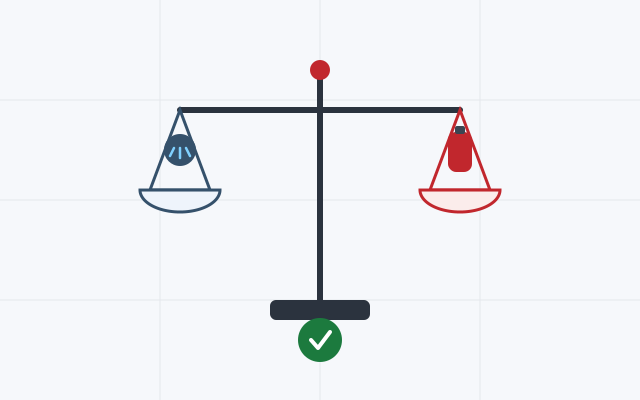
There is no universally "best" fire suppression system. There is only the right system for a specific hazard, in a specific room, protecting specific assets and people, within a realistic budget. A gaseous clean-agent system that is ideal for a data hall would be an expensive mistake in a warehouse; a sprinkler array that protects a shopping mall could destroy the equipment it was meant to save in a server room. Choosing a fire suppression system well means resisting the temptation to start with a product and instead starting with the risk.
This guide gives you a repeatable way to reach that decision. We walk through the five questions that frame every selection, compare the main system families in a single table, and set out the questions to ask a supplier and the red flags that should make you pause. Used properly, the framework tells you which technology fits. It also tells you when a standard package is enough and when you need a bespoke, engineered design.
The five-question selection framework
Before any product is named, five questions decide the shape of the solution. Answer them honestly and most of the market narrows itself down for you.
- What is the hazard? What can actually burn, and how? Solid combustibles, flammable liquids, cooking oils, energised electrical equipment, lithium batteries and reactive metals each behave differently. The fuel dictates which extinguishing mechanism will work: cooling, smothering, chemical interruption or oxygen reduction.
- What are you protecting? The replacement value and sensitivity of the assets matter as much as the fire itself. Irreplaceable data, precision electronics, archives and clean-process equipment can be ruined by the very water or residue that would put the fire out.
- Who and what occupies the space? Occupancy changes the rules. A normally occupied room limits how far you can reduce oxygen or use certain agents; an unoccupied plant room gives you more freedom. Escape routes, warning times and manual overrides all flow from this.
- How much downtime can you tolerate? A fire that is extinguished but leaves you unable to trade for a week may cost more than the fire. Clean, residue-free agents and fast reset times reduce business interruption; water-based systems maximise life safety but can extend recovery.
- What is the realistic budget over the whole life? Purchase price is only part of the story. Refill cost after a discharge, annual maintenance, room-sealing works and the cost of false or accidental activation all belong in the comparison.
The most common and most expensive selection error is choosing a technology first and forcing the hazard to fit it. A short, structured fire-risk assessment answers all five framework questions and turns a shopping decision into an engineering one. Our consulting and risk assessment service exists to complete this step before any specification is written.
Comparison of fire suppression system types
The table below compares the main families used across the sectors we serve. Read it as a shortlist tool, not a verdict: several systems can be "suitable" for a hazard, and the final choice depends on the asset, occupancy, downtime and budget answers above. Relative cost is indicative and rises sharply with room size, agent quantity and integrity works.
| System type | Best-suited hazards | Effect on protected assets | Human safety in occupied space | Relative cost | Maintenance demand |
|---|---|---|---|---|---|
| Sprinkler / water | General building life safety, ordinary combustibles, warehousing, retail | Water damage to stock, electronics and finishes; wetting is localised to activated heads | High, well proven for occupied buildings | Low to medium | Low; periodic flow and valve checks |
| Water mist | Machinery spaces, marine, heritage, areas wanting fire control with less water | Far less water than sprinklers; still unsuitable for live electronics | High | Medium to high | Medium; fine nozzles and high-pressure pumps need care |
| Foam | Flammable-liquid pools, fuel stores, aircraft hangars, process areas | Significant residue; clean-up required after discharge | Medium, depends on foam type and enclosure | Medium | Medium; concentrate condition and proportioning must be verified |
| Gaseous clean agent | Server rooms, control rooms, telecoms, sensitive electronics and archives | Residue-free; no water damage, assets typically usable after venting | Designed for occupied spaces at approved concentrations | High | Medium; cylinder weighing, room-integrity testing |
| Inert gas | Larger IT/data halls, switchrooms, high-value technical spaces | Residue-free; extinguishes by reducing oxygen | Occupiable within design limits; safe egress must be assured | High to very high | Medium; large cylinder banks and integrity testing |
| Wet-chemical (kitchen) | Commercial cooking lines, hoods and ducts, deep-fat fryers, cooking-oil fires | Foamy residue on cooking surfaces; contained to the appliance zone | High, protects staff on the cooking line | Low to medium | Medium; six-monthly service typical, nozzle caps checked |
| Condensed aerosol | Small unoccupied enclosures, switch cabinets, engine bays, compact plant | Fine residue that may need cleaning from sensitive electronics | Best in normally unoccupied spaces | Low | Low; sealed generators, few moving parts |
Notice how the trade-offs cluster. Water-based systems lead on life safety and cost but carry collateral-damage risk. Sprinkler installations are designed and tested to EN 12845, water mist to EN 14972. Gaseous systems protect assets and reset cleanly, though they cost more and need a sealed room; a clean-agent design follows EN 15004 (ISO 14520). Specialised agents such as wet-chemical and foam exist because a particular fuel demands them, with commercial kitchen protection governed by EN 16282-7. For a deeper treatment of each technology, see our complete guide to fire suppression systems.
Matching the agent to your hazard
The comparison table narrows the field; matching the agent to the exact hazard finishes the job. A few decisive patterns recur across the projects we handle:
- Energised electronics and data: water and residue are the enemy. Gaseous clean agents or inert gas are the natural choice, both designed to EN 15004. Our dedicated guide to server room fire protection covers detection, room integrity and over-pressure considerations.
- Commercial cooking: hot cooking oils re-ignite and cannot be safely handled by general-purpose agents. A wet-chemical system engineered for the hood and duct is the standard answer, as explained in our kitchen fire suppression guide.
- Flammable liquids: pool fires are smothered, not merely cooled, so foam or specialised agents dominate. Sprinklers alone rarely suffice.
- General occupied buildings: where the priority is getting people out safely and the assets are ordinary, sprinklers or water mist remain the proven, economical backbone.
- Compact unoccupied enclosures: switch cabinets and machinery bays are ideal for condensed aerosol or a small clean-agent unit, where a full pipe network would be disproportionate.
Most real buildings are protected by a combination of systems, each matched to a zone: sprinklers for the general floor, clean agent for the server room, wet-chemical over the kitchen. Choosing a fire suppression system is therefore usually a set of coordinated decisions rather than a single one. Coordinating them under one accountable partner avoids gaps where trades meet.
Questions to ask a supplier
Whether you are evaluating a packaged product or a full engineered design, the same questions separate a serious proposal from a sales pitch. Bring this checklist to every meeting.
- What is the identified hazard, and why does this agent suit it? The answer should reference your specific fuel load, not a generic brochure.
- Which standards and approvals does the design follow? Ask for the specific standard the system is designed and tested to, whether that is EN 12845 for sprinklers, EN 14972 for water mist, EN 15004 or ISO 14520 for a gaseous system, or EN 16282-7 for a kitchen.
- Is the space occupied, and how is human safety assured? Concentration limits, warning times, egress and manual override must be spelled out.
- What is the whole-life cost? Purchase, installation, annual maintenance, refill after discharge and any room-sealing works.
- What happens after a discharge? Clean-up, downtime, recharge lead time and how quickly you can resume operations.
- How is false activation prevented? Detection type, double-knock logic and abort provisions where appropriate.
- Who is accountable for design, install and service? A single point of responsibility reduces the risk of gaps between contractors.
- Can you provide references for similar hazards? Comparable projects are more telling than a long product catalogue.
Red flags to avoid
Certain warning signs recur often enough to be worth naming. Any one of them justifies a second opinion before you commit budget.
- No risk assessment. A quote that arrives without anyone surveying the hazard is a price, not a solution.
- One agent for everything. A supplier who proposes the same technology for a kitchen, a server room and a warehouse is selling stock, not fit.
- Silence on standards. If the proposal cannot name the standard it is designed to, such as EN 12845 or EN 15004, it cannot be verified.
- Hidden whole-life costs. Missing refill, maintenance or room-integrity costs make a cheap day-one price misleading.
- No occupancy analysis. Proposing a gas system for an occupied room without addressing safe concentration and egress is a serious omission.
- Reluctance to explain. If a supplier will not justify why an agent was chosen, treat the recommendation as unproven.
When you need a bespoke engineered system
Packaged, pre-engineered systems are excellent when the hazard is predictable and well understood: a standard kitchen line, a modest switch cabinet, a small technical room. They are quick to specify, economical and proven. But some situations sit outside that envelope, and forcing a packaged product onto them is where selection goes wrong.
You should expect a bespoke, engineered solution when any of the following apply:
- The protected enclosure needs a calculated agent concentration and a room-integrity (door-fan) test, as EN 15004 requires for gaseous and inert-gas systems in data and technical spaces.
- The hazard is mixed or unusual: multiple fuel types, complex machinery, or a process that changes through the day.
- The asset value or sensitivity is high, so that collateral damage from the agent itself must be engineered out, not accepted.
- The geometry is awkward: high ceilings, open plan, heavy airflow or obstructions that a standard nozzle layout cannot cover reliably.
- Several systems must be integrated with detection, ventilation shutdown, alarms and building management under a coordinated cause-and-effect.
An engineered design starts from your room, fuel load and airflow and calculates the agent, quantity, nozzle layout and detection logic to suit. It costs more in design time but removes the guesswork, and with it the risk of a system that looks compliant yet fails to control the real fire.
How independent consulting de-risks the decision
The structural weakness of buying fire protection is that the party recommending the system often sells it. Even with the best intentions, a supplier's catalogue shapes the advice. Independent, vendor-neutral consulting breaks that link: the specification is written to serve the hazard, not the stockroom.
In practice, independent consulting de-risks choosing a fire suppression system in four ways. It completes a proper risk assessment so the five framework questions are answered with evidence. It produces a technology-agnostic specification that any competent contractor can quote against, keeping the market honest and the pricing fair. It brings whole-life cost, meaning maintenance, refills and downtime, into the decision rather than the day-one price alone. And it holds the design to the applicable standards, EN 12845, EN 14972, EN 15004 or EN 16282-7 as the hazard dictates, plus EN 54 for the detection that triggers them, so the finished system can be verified rather than merely trusted.
At VAALMAX we combine that independence with the ability to install and maintain, which means the advice can be carried through to a clean, code-compliant installation and a documented lifecycle, without responsibility falling between trades. If you are weighing options, our services overview and contact page are the fastest way to start a no-obligation conversation.
Choose the system that controls your actual hazard, protects your actual assets, keeps your actual occupants safe, and fits your whole-life budget, in that order. Any recommendation that skips straight to a product has skipped the decision.
Frequently asked questions
What is the single most important factor when choosing a fire suppression system?
The hazard itself: what can burn and how. The fuel type (solids, flammable liquids, cooking oils, energised electronics) dictates which extinguishing agents are effective and safe. Asset value, occupancy, downtime and budget refine the choice after that. An agent that cannot control the actual fire is the wrong system at any price.
Can one fire suppression system protect an entire building?
Rarely with a single technology. Most buildings combine methods: sprinklers or water mist for general life safety, a clean-agent or inert-gas system for the server room, and wet-chemical protection over the kitchen line. Choosing a fire suppression system is usually about zoning the building and matching each area to the right approach.
How do I know if I need a bespoke engineered system?
You need an engineered solution when the hazard is unusual, mixed or high-value: enclosures needing a calculated gas concentration and room-integrity test, complex machinery, mixed fuels, or assets where water damage would be as costly as the fire. Standardised packaged systems suit predictable, well-understood hazards; anything outside that envelope should be designed to your specific room, fuel load and airflow.
What are the biggest red flags when a supplier quotes a system?
A quote with no risk assessment, one agent proposed for every situation, no reference to the standard the design follows (EN 12845 for sprinklers, EN 15004 or ISO 14520 for gaseous systems, EN 16282-7 for kitchens), missing maintenance and refill costs, and reluctance to explain why a technology was chosen. A credible supplier justifies the agent against your hazard and shows the whole-life cost, not just the day-one price.
Choosing a fire suppression system is a disciplined decision, not a product purchase. Answer five questions on hazard, assets, occupancy, downtime and whole-life budget, then use the comparison table to shortlist the technologies that fit. Match the agent precisely to the fuel, think in zones rather than one silver bullet, and interrogate every proposal with the supplier questions and red flags above. When the hazard is unusual or high-value, expect a bespoke engineered design. Where you want the advice to serve the risk rather than a catalogue, independent consulting is what de-risks the whole decision.
Not sure which system fits your risk?
Tell us about your building, process or assets, and we will recommend the right suppression strategy, independently and with no obligation.